Bringing a new puppy home is one of the most exciting things you will ever do. But let me tell you, as a lifelong pet enthusiast, it can also be incredibly stressful. One question always seems to cause the most panic: how much to feed a puppy by weight kg? You want your little friend to grow up strong, but you definitely do not want to overfeed them and cause joint problems down the road.
I have been there, staring at the back of a dog food bag, totally confused by the charts and serving sizes. It feels like you need a math degree just to figure out a single meal! Here’s the good news. Feeding your puppy does not have to be a guessing game. Once you understand a few basic rules about your puppy’s weight and growth stage, the whole process becomes simple.
In this guide, I will break down exactly how to calculate your puppy’s food portions based on their weight in kilograms. We will cover how to read those tricky feeding charts, how to adjust portions as they grow, and the common feeding mistakes you need to avoid to keep your furry best friend healthy.
Quick Answer
If you are wondering exactly how much to feed a puppy by weight kg, a good general rule is to feed them about 20 grams of high-quality dry puppy food per 1 kilogram of their current body weight each day. However, this is just a starting point. The exact amount depends on their age in months, their breed size, and the calorie density of the specific food you are using. You should always divide their total daily food allowance into three or four smaller meals to support their fast metabolism and keep their digestion steady.
Why Feeding by Weight Matters
You might be wondering why we use weight in kilograms to figure out food portions. Let me explain. Puppies grow at an incredible rate during their first year of life. A Great Dane puppy and a Chihuahua puppy have completely different nutritional needs, even if they are the exact same age in weeks.
Basing your puppy’s meals on their body weight ensures they are getting the right amount of calories to fuel their specific growth spurt. If you just guess the amount, or use the same measuring cup size for every breed, you run a huge risk. Underfeeding can stunt their growth and leave them lacking essential nutrients for brain and bone development. Overfeeding, on the other hand, can cause them to grow too fast. In large breeds, growing too quickly puts dangerous stress on their developing joints and can lead to lifelong skeletal issues.
By tracking their weight in kilograms weekly, you can make tiny, accurate adjustments to their daily food intake. This method keeps their growth curve steady and healthy, just like veterinary nutritionists recommend.
- Growth speed: Small breeds reach their adult weight faster than large breeds.
- Caloric density: Not all puppy foods are the same. One cup of brand A might have 300 calories, while brand B has 450.
- Metabolism: Puppies burn way more energy than adult dogs just by growing, playing, and learning.
How to Tell If Your Puppy Is Getting the Right Amount
Even with the best math and the clearest feeding charts, every puppy is an individual. Some are highly active and burn off calories like a marathon runner, while others love to snooze on the couch. Because of this, the most important skill you can learn is how to read your puppy’s body condition.
You should not just rely on the scale. You need to use your hands and your eyes. Vets use something called a Body Condition Score to tell if a dog is too skinny, too heavy, or just right. Checking this every week will tell you if you need to increase or decrease the food amount you calculated.
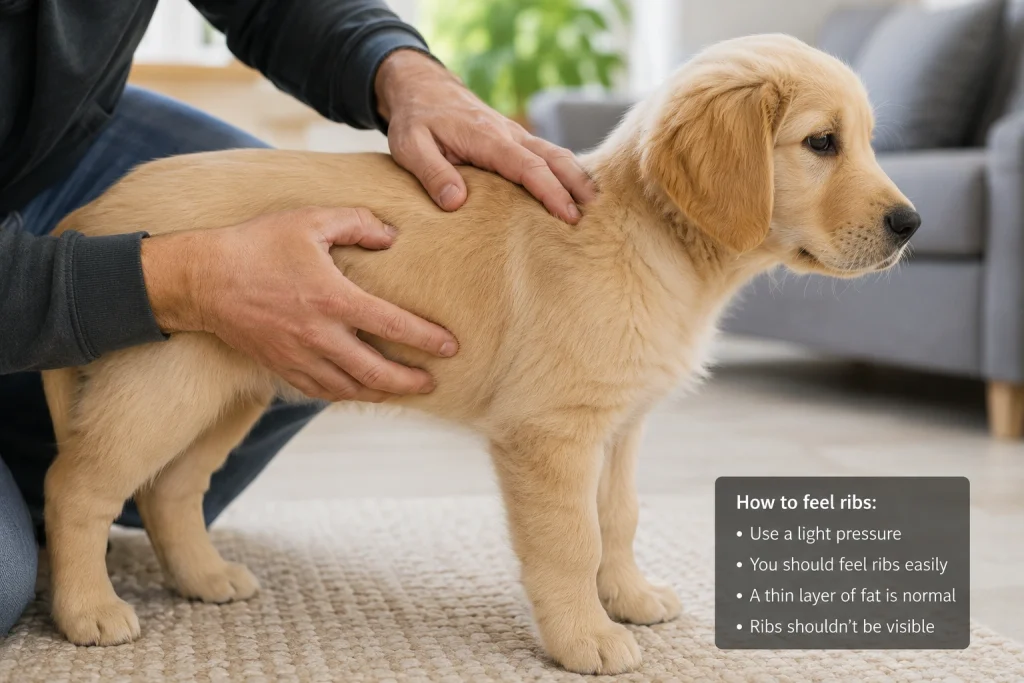
Here is what you need to look out for to ensure your portion sizes are hitting the mark:
| Body Condition | Visual Signs | Physical Touch (The Rib Test) | Action Needed |
|---|---|---|---|
| Underweight | Ribs, spine, and hip bones are highly visible from a distance. Extreme tuck in the belly. | Bones feel sharp with no layer of fat covering them. | Increase daily food amount slightly and consult your vet. |
| Ideal Weight | You can see a clear waistline when looking down from above. Tucked up tummy from the side. | You can feel the ribs easily with light pressure, like the back of your hand. | Keep doing what you are doing! Adjust only as they gain weight. |
| Overweight | No visible waistline. The body looks round or tubular. The belly hangs down or sags. | You have to press hard to feel the ribs under a thick layer of fat. | Reduce daily portions and cut back on extra treats. |
How to Calculate Puppy Food by Weight KG Step by Step
Alright, let’s get down to the practical steps. Figuring out how much to feed a puppy by weight kg is easier than it looks. You just need your puppy, a scale, and the bag of food you plan to use.
If you want to be incredibly precise, you can check the World Small Animal Veterinary Association (WSAVA) guidelines for exact calorie requirements, but for everyday pet parents, following these simple steps works best.
- Weigh your puppy accurately: Do not guess their weight. Pick up your puppy and step on your bathroom scale. Note the total weight. Then, put the puppy down and weigh just yourself. Subtract your weight from the total. Now you have your puppy’s exact weight in kilograms.
- Check the feeding chart on the bag: Turn your bag of puppy food around. Most high-quality brands provide a chart based on the puppy’s current weight in kg and their age in months. Find the column that matches their age and the row that matches their weight.
- Divide by the number of meals: The amount listed on the bag is always for the whole day. If the bag says 150 grams per day, and your puppy is 3 months old, divide that into three meals. That equals 50 grams per meal.
- Measure the food by weight, not volume: Cups are highly inaccurate. A scooped cup can vary by 20% depending on how the kibble settles. Buy a cheap digital kitchen scale and weigh the food in grams. This is the secret to perfect portion control.
- Adjust weekly: Your puppy is going to grow fast. You must weigh them every single week and adjust the total daily amount based on their new weight.
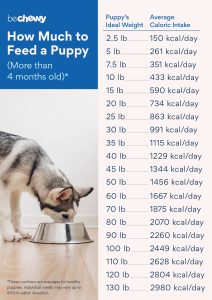
To give you a general idea of what a feeding chart looks like, here is a standard baseline. Keep in mind, this is an estimate for standard dry kibble. Always defer to the specific instructions on your dog food packaging.
| Puppy’s Current Weight (kg) | Age 2-3 Months (Total Daily Amount) | Age 4-6 Months (Total Daily Amount) | Age 7-12 Months (Total Daily Amount) |
|---|---|---|---|
| 2 kg | 60 – 80 grams | 50 – 70 grams | 40 – 60 grams |
| 5 kg | 120 – 150 grams | 100 – 130 grams | 80 – 110 grams |
| 10 kg | 200 – 240 grams | 170 – 210 grams | 140 – 180 grams |
| 15 kg | 270 – 320 grams | 230 – 280 grams | 190 – 240 grams |
| 20 kg | 340 – 400 grams | 290 – 350 grams | 240 – 300 grams |
Common Feeding Mistakes to Avoid
Even when you know the math, it is easy to make simple mistakes that can upset your puppy’s tummy or mess up their growth. Here are the most common traps I see new pet parents fall into.
- Free-feeding: Leaving a bowl of food out all day is a bad idea. It makes potty training nearly impossible, and puppies will often overeat just out of boredom. Stick to scheduled mealtimes.
- Forgetting to count treats: Training takes a lot of treats, and those calories add up fast. Treats should never make up more than 10% of your puppy’s daily calorie intake. If you do heavy training one day, reduce their dinner slightly to balance it out.
- Switching foods too quickly: Puppies have very sensitive stomachs. If you need to change their food brand, you must do it slowly over 7 to 10 days. Mix a little of the new food into the old food, gradually increasing the ratio to avoid terrible diarrhea.
- Following the bag blindly: The bag is just a guide, not a law. If the bag says to feed 200 grams, but your puppy is getting chubby, you need to cut back. Always feed the dog in front of you, not the label on the bag.
- Using adult dog food too soon: Puppy food has specific levels of calcium, phosphorus, and protein required for growth. Feeding an AAFCO-approved adult maintenance food too early can cause severe developmental issues, especially in large breeds.
Expert Tips from Zak
Over the years, I have raised a few puppies and helped plenty of friends through the chaotic first year of pet ownership. Through trial and error, I have found a few tricks that make mealtime much easier and safer for everyone involved.
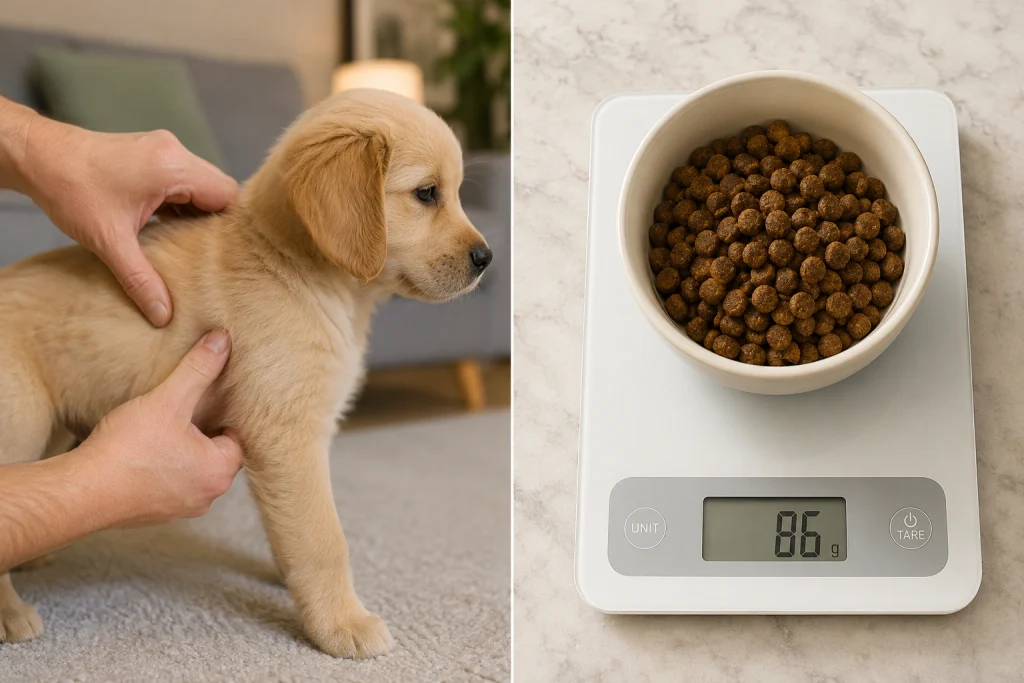
Zak’s Tip: Soak the kibble for young pups. If your puppy is between 8 and 10 weeks old, their baby teeth might still be quite small and sensitive. Taking their weighed portion of dry kibble and soaking it in a splash of warm water for ten minutes makes it much easier for them to chew and digest. Plus, it adds extra hydration to their diet.
Zak’s Tip: Ditch the scoop, use the scale. I cannot stress this enough. Throw away the plastic measuring cups. Invest in a digital kitchen scale and weigh your puppy’s meals in grams. You will be amazed at how much a standard cup can overfeed your dog without you even realizing it. It takes exactly the same amount of time to pour food onto a scale as it does into a cup.
Zak’s Tip: Use food for mental stimulation. You do not always have to feed your puppy from a standard bowl. You can take their measured meal for the day and put it inside a puzzle toy, a stuffed Kong, or use it as rewards for obedience training. This tires them out mentally, which is often more exhausting for a puppy than a long walk!
Key Takeaways
- Knowing how much to feed a puppy by weight kg requires weekly weigh-ins to match their rapid growth.
- Always check the manufacturer’s feeding chart, but adjust based on your puppy’s individual body condition score.
- Weighing food on a digital kitchen scale in grams is far more accurate and safer than using measuring cups.
- Remember to subtract the calories from training treats out of their total daily food allowance.
- Stick to a strict feeding schedule of 3 to 4 meals a day to aid digestion and help with potty training.
Frequently Asked Questions
How often should I feed my puppy per day?
Puppies under six months old should generally be fed three to four times a day. Their small stomachs cannot handle a whole day’s worth of food at once. After six months, you can usually reduce this to two meals a day.
Should I feed my puppy based on current weight or estimated adult weight?
Most standard puppy food brands recommend feeding based on their current body weight and age. However, some large-breed specific formulas chart feeding based on estimated adult weight. Always read the specific instructions on the bag you are using.
When do I switch from puppy food to adult food?
Small breed dogs can switch to adult food around 9 to 12 months of age. Medium breeds usually switch around 12 to 14 months. Large and giant breeds take much longer to mature and should stay on large-breed puppy food until they are 18 to 24 months old.
Can I add human food to my puppy’s diet?
While safe toppers like plain boiled chicken or a spoonful of plain pumpkin are okay occasionally, it is best to avoid adding human food regularly. It can unbalance the specific nutrients in their puppy food and create a picky eater.
Why is my puppy always acting hungry?
Puppies are growing fast and naturally have huge appetites. It is normal for them to act like they are starving even after eating. As long as their body condition score is ideal and they are gaining weight steadily, do not give in to the begging.
What if my puppy refuses to eat their kibble?
If your puppy skips a meal, do not panic. Pick the bowl up after 15 minutes and try again at the next scheduled mealtime. If they refuse to eat for more than 24 hours, or seem sluggish and sick, contact your vet immediately.
Conclusion
Figuring out how much to feed a puppy by weight kg is a learning curve, but it is one you will master quickly. The secret is simply staying consistent. Buy a reliable kitchen scale, weigh your puppy weekly, weigh their food portions accurately, and keep a close eye on their body shape. Do not let the charts on the dog food bags intimidate you; they are just tools to guide you in the right direction.
Remember, the effort you put into their nutrition right now sets the foundation for their entire life. Keeping them at a lean, healthy weight protects their growing joints and ensures they develop into strong, happy adult dogs. If you are ever in doubt about their growth rate, your local veterinarian is your best resource for personalized advice.
Now that you have the feeding schedule sorted out, you might want to look into getting the right equipment to serve those perfect meals. Check out our guide on the best dog bowls to find safe, durable options for your growing pup, or dive into some puppy training basics to put those daily kibble portions to good use!