By Zak Fahim
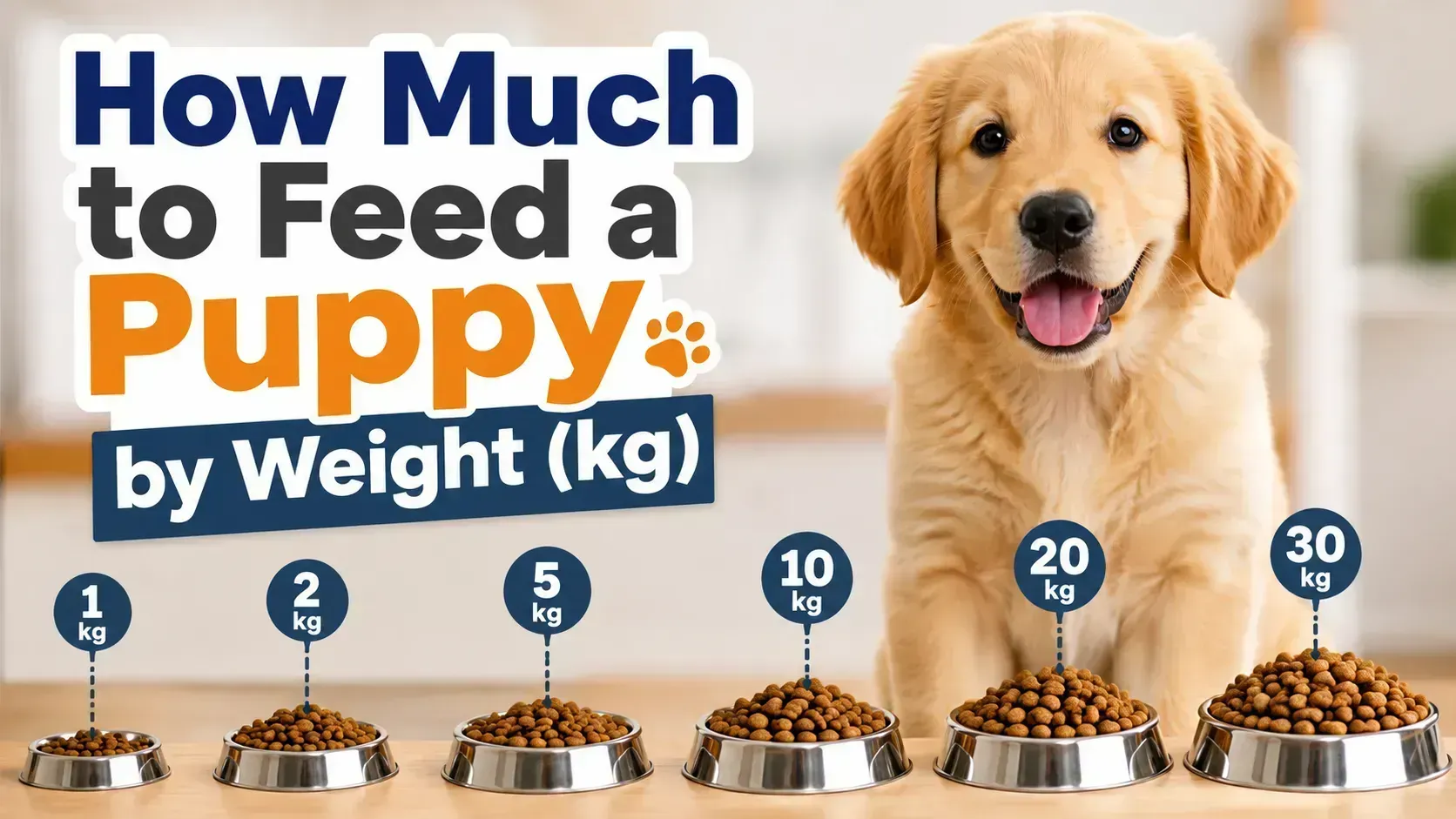
Body weight is one of the best starting points for working out how much food a puppy needs. A 2 kg puppy cannot eat the same portion as a 20 kg puppy. However, weight alone does not tell the whole story.
Two puppies can weigh the same but need different amounts of food. Their age, breed, expected adult size, activity, body condition, and food type all affect their daily needs.
In this guide, I will show you how to use your puppy’s weight in kilograms to estimate calories and food portions. You will also learn how to divide the daily amount into meals, check body condition, adjust portions, and spot signs that your puppy may be eating too much or too little.
Important: This article provides general feeding guidance. I am not a veterinarian. Contact a licensed veterinarian if your puppy has poor growth, abnormal weight gain, repeated vomiting, diarrhea, weakness, refusal to eat, dehydration, or another worrying symptom.
Quick Answer
Start with your puppy’s current weight, age, and the feeding guide printed on the food package. A healthy puppy under four months may need about three times its resting energy requirement, while an older puppy may need closer to twice its resting energy requirement. Convert calories into grams by dividing the puppy’s daily calorie target by the food’s calories per gram. Split the result into three or four meals for young puppies and usually two meals for older puppies. Check weight and body condition every one to two weeks because calculated portions are only starting estimates.
Why Weight Matters More Than Age Alone
Age is useful, but puppies do not all grow at the same speed. A three-month-old Chihuahua may weigh less than 2 kg, while a three-month-old large-breed puppy may already weigh more than 10 kg.
Body weight helps estimate the amount of energy needed for basic body functions, movement, digestion, tissue growth, and normal puppy development. Still, calorie needs do not rise in a straight line with weight. A 20 kg puppy does not simply need ten times as many calories as a 2 kg puppy.
Veterinary calorie calculations often begin with resting energy requirement. The common formula is:
Resting energy requirement = 70 × body weight in kilograms raised to the power of 0.75
For healthy puppies, a general starting estimate is about three times resting energy requirement before four months of age and about two times resting energy requirement after four months. Individual dogs may need around 30% more or less than a calculated figure, so the puppy’s response matters more than the number alone.
Feeding charts also vary because foods contain different amounts of energy. One dry puppy food may provide 3.6 calories per gram, while another may provide more than 4 calories per gram. Wet food contains more water, so a puppy normally needs a heavier portion in grams to receive the same calories.
Puppy Feeding Chart by Weight (kg)
The following puppy feeding chart by weight in kilograms gives broad dry-food estimates. The ranges assume a complete puppy food containing about 3.6 to 4.2 calories per gram and an estimated energy need between two and three times resting energy requirement.
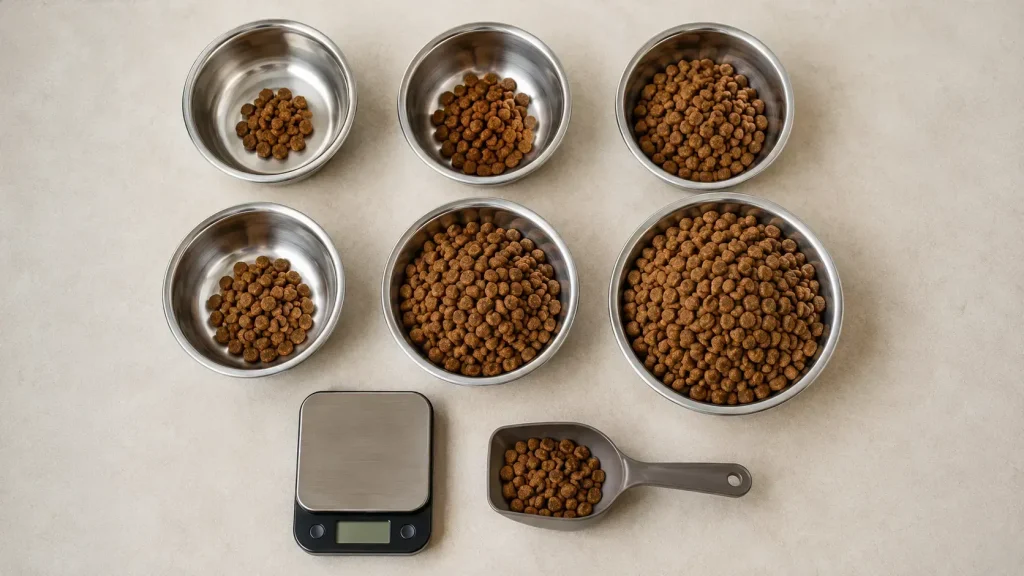
These ranges are not prescriptions. Check your product label because the correct gram amount can change greatly between foods. The puppy’s age, expected adult size, activity, neuter status, and body condition must also be considered.
| Weight | Approximate Dry Food Per Day | Meals Per Day | Typical Age Range | Notes |
|---|---|---|---|---|
| 1 kg | 35–60 g | 4–6 | Often 8–16 weeks in toy breeds | Tiny puppies may need very small, frequent meals. |
| 2 kg | 55–100 g | 4 | Often 8–20 weeks in toy or small breeds | Divide the food evenly and track energy between meals. |
| 3 kg | 75–135 g | 3–4 | Often 8–24 weeks in small breeds | Use the lower end for older or less active puppies. |
| 5 kg | 110–195 g | 3–4 | Often 10–28 weeks | Food density can change this amount by many grams. |
| 7 kg | 145–250 g | 3–4 | Often 12–32 weeks | Check the ribs and waist rather than filling the bowl by eye. |
| 10 kg | 190–330 g | 3 | Often 12–36 weeks | A young 10 kg puppy may need much more than an older one. |
| 15 kg | 255–445 g | 3 | Often 16–44 weeks | Large-breed growth food may be needed. |
| 20 kg | 315–550 g | 2–3 | Often 20–52 weeks | Keep growth controlled and avoid free-feeding. |
| 25 kg | 375–650 g | 2–3 | Often 6–14 months | Expected adult size matters when choosing the food. |
| 30 kg or more | 430–750 g or more | 2–3 | Often 7–18 months in large or giant breeds | Use a veterinarian-guided growth plan for giant breeds. |
The typical age ranges are only examples. A puppy may reach a listed weight much earlier or later because breed sizes differ so much.
How to Calculate How Much Food Your Puppy Needs
Step 1: Weigh Your Puppy Accurately
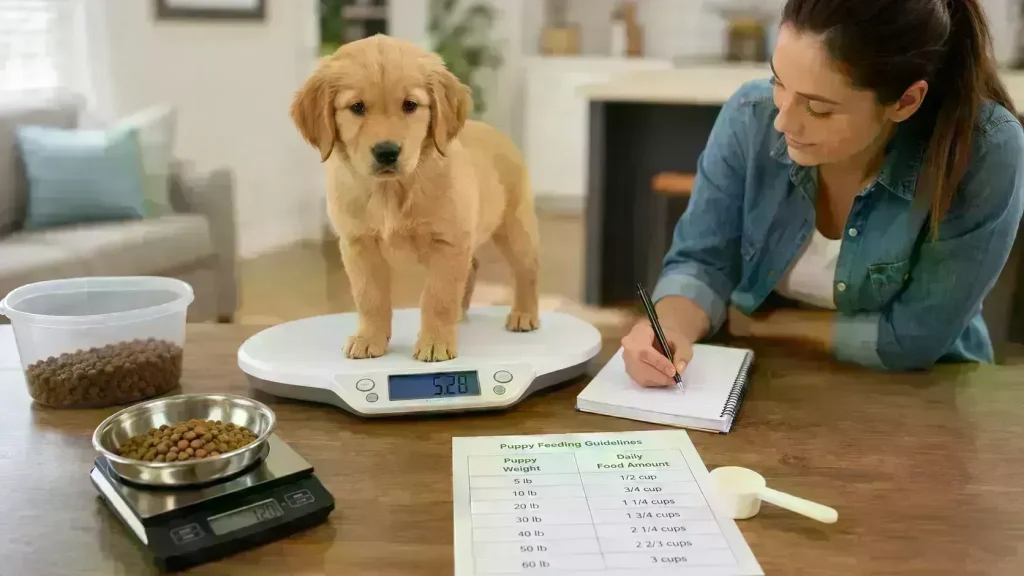
Use a pet scale or bathroom scale. For a small puppy, weigh yourself first. Then hold the puppy and weigh again. Subtract your weight from the combined number.
Try to weigh the puppy at the same time of day, preferably before a meal. Weekly weighing makes changes easier to spot.
Step 2: Read the Food Package
Find the nutritional adequacy statement, feeding guide, and calorie content. Choose food marked as complete and balanced for growth or all life stages. Large and giant puppies should receive a growth food suitable for large-size dogs.
AAFCO explains that growth food must provide nutrients in suitable amounts and ratios for puppies. Feeding directions are starting guidelines and may need to be changed according to the animal’s condition and activity.
Step 3: Match Weight and Age
Some packages use current body weight. Others use expected adult weight. Read the heading carefully. Using the wrong column can lead to a large feeding error.
Step 4: Divide the Daily Amount
Suppose the package recommends 160 g per day and your puppy eats four meals:
160 g ÷ 4 meals = 40 g per meal
Do not add four full daily portions. The printed amount usually means the total for the whole day.
Step 5: Check Body Condition
Feel the ribs and look at the waist. A healthy puppy should have a visible shape without looking bony. Body condition is more useful than an empty bowl or begging behavior.
Step 6: Recalculate Every One to Two Weeks
Puppies grow quickly, especially during the first five months. Reweigh the puppy, check the package chart again, and review body condition. Growth often begins to slow after six months, although large and giant breeds may continue developing for much longer.
Puppy Food Calculator Formula
You can use this simple method when the food label lists calories:
- Calculate resting energy requirement: 70 × weight in kg0.75.
- Multiply by 3 for a healthy puppy under four months.
- Multiply by 2 for a healthy puppy over four months.
- Divide daily calories by the food’s calories per gram.
Example: A 5 kg puppy has a resting energy requirement of about 234 calories. A younger puppy may start near 702 calories per day. If the food contains 4 calories per gram, the estimate is about 176 g daily.
This figure must still be checked against the package directions, breed growth pattern, and body condition.
Daily Meal Portions by Weight
1–5 kg Puppies
Small puppies need small portions, but they may need meals more often. A 1 kg puppy cannot comfortably eat a full day’s food in one or two servings. Divide the total carefully and use a gram scale.
5–10 kg Puppies
Many puppies in this range eat three or four times daily. For example, a 7 kg puppy eating 210 g per day could receive three 70 g meals.
10–20 kg Puppies
These puppies may be medium breeds or young large breeds. Expected adult size becomes important. A 15 kg puppy expected to reach 25 kg may have different needs from one expected to reach 50 kg.
20–30 kg Puppies
Controlled growth matters more than rapid growth. Avoid adding calcium or other supplements unless a licensed veterinarian recommends them. Use measured meals and monitor the puppy’s shape.
Giant-Breed Puppies
A giant-breed puppy may remain on growth food well beyond one year. Feeding too much does not build a stronger dog. It can cause excess body weight to place more stress on developing joints.
Feeding Frequency by Weight and Age
| Age or Puppy Type | Meals Per Day | Reason | Practical Schedule |
|---|---|---|---|
| Toy puppy under 3 months | 4–6 | Very small stomach and steady energy needs | Early morning, midmorning, noon, afternoon, evening, optional late meal |
| 6–12 weeks | 4 | Fast growth and limited meal capacity | 7 a.m., 11 a.m., 3 p.m., 7 p.m. |
| 3–6 months | 3 | The stomach can handle larger meals | 7 a.m., 1 p.m., 7 p.m. |
| 6–12 months | 2–3 | Growth energy begins to slow | Breakfast and dinner, with a midday meal if needed |
| Older puppy near maturity | 2 | Supports a regular adult-style routine | Morning and evening |
Small, frequent meals are easier for young puppies to digest and help provide steady energy. Many puppies move from four meals to three around three or four months, then toward two meals after about six months. Toy breeds may need frequent meals for longer.
Feeding Amount by Growth Stage
8 Weeks
At eight weeks, most puppies need four measured meals. Growth is fast, but the stomach is still small. Keep the same food used by the breeder or rescue at first when possible.
3 Months
Portions normally rise as body weight increases. Many puppies still need four meals, although some medium breeds can begin moving toward three.
4 Months
The energy multiplier often begins to fall after four months. The puppy may eat more grams than before because it weighs more, but it usually needs fewer calories for each kilogram of body weight.
6 Months
Many puppies can eat two or three meals. Growth starts to slow, so this is a common time for accidental overfeeding. Do not keep increasing portions just because the puppy is older.
9 Months
Toy and small breeds may be close to adult size. Large breeds may still have months of growth ahead. Continue checking expected adult size and body condition.
12 Months
Many small and medium dogs can transition to adult food by this age. Large and giant breeds may still need puppy food. Small and medium breeds may reach skeletal maturity around 8–12 months, while larger dogs can take longer.
How Food Type Changes Portion Size
Grams are not equal across food types. Always compare calories, not only weight or volume.
| Food Type | Example Energy Density | Example Amount for 400 Calories | What to Check |
|---|---|---|---|
| Dry kibble | 4 calories per gram | 100 g | Calories per cup and per kilogram |
| Wet food | 1 calorie per gram | 400 g | Can size and calories per can |
| Mixed feeding | Varies | Split calories between foods | Avoid giving a full daily amount of both foods |
| Fresh food | 1.5 calories per gram | About 267 g | Complete growth formulation and storage directions |
| Freeze-dried food | 4.5 calories per gram | About 89 g | Rehydration directions and calorie density |
The figures above are simple examples, not standard values for every product. Check the actual calorie statement on the package.
For mixed feeding, choose a calorie split. If a puppy needs 600 calories daily and you want half from dry food and half from wet food, each food should provide about 300 calories. Do not serve the full dry-food portion and then add the full wet-food portion.
Feeding by Breed Size
| Breed Size | Expected Adult Weight | Feeding Focus | Common Adult-Food Transition |
|---|---|---|---|
| Toy | Up to about 5 kg | Small, frequent meals and easy-to-eat pieces | About 8–12 months |
| Small | About 5–10 kg | Frequent early meals and close weight tracking | About 8–12 months |
| Medium | About 10–25 kg | Steady growth and portion adjustment | About 10–12 months |
| Large | About 25–45 kg | Lean, controlled growth with large-breed puppy food | About 12–18 months |
| Giant | More than about 45 kg | Slow skeletal growth and veterinarian-guided monitoring | About 18–24 months |
Use these ranges as general guides. Breed, individual development, and skeletal maturity should guide the final decision. Complete growth food should continue until the puppy is near maturity, and large or giant puppies should receive food formulated for their growth needs.
Activity Level and Portion Adjustments
Indoor Puppies
A calm puppy that spends much of the day resting may need the lower end of the feeding range. Indoor living alone does not prove low activity, so judge the puppy’s actual play and body condition.
Highly Active Puppies
A puppy that trains, plays, and walks often may need a small increase. Add food gradually rather than making a large change after one busy day.
Sporting Breeds
Sporting breed does not automatically mean unlimited food. Age-appropriate activity, weather, body condition, and training load should guide changes.
Puppies Recovering From Illness
Do not use a standard puppy food calculator for a sick or recovering puppy without professional guidance. Illness can raise or lower calorie needs. Vomiting, diarrhea, refusal to eat, weakness, and weight loss require advice from a licensed veterinarian.
Body Condition Score
Body Condition Score is a hands-on way to check body fat. The common system runs from 1 to 9. A score near 4 or 5 is generally considered ideal.
| Score | What You May Notice | Feeding Response |
|---|---|---|
| 1–2 | Ribs, spine, and hip bones are very clear | Contact a veterinarian promptly. |
| 3 | Ribs are easy to see with very little fat | Review growth, calories, parasites, and health with a veterinarian. |
| 4–5 | Ribs are easy to feel, waist is visible, belly tucks upward | Continue the plan and monitor. |
| 6 | Ribs are harder to feel and waist is less clear | Reduce treats and consider a small portion adjustment. |
| 7 | Noticeable fat and little waist | Ask a veterinarian to review the growth plan. |
| 8–9 | Heavy fat cover with no clear waist | Seek a veterinarian-led feeding plan. |
The WSAVA body condition chart describes an ideal dog as having ribs that are easy to feel, a visible waist from above, and an abdominal tuck from the side.
Body Condition Checklist
- Can I feel the ribs without pressing hard?
- Can I see a waist behind the ribs?
- Does the belly rise toward the back legs?
- Is weight following a steady growth path?
- Is the puppy active with a healthy-looking coat?
Signs You May Be Feeding Too Much
- Weight rises faster than the expected growth pattern.
- The waist becomes difficult to see.
- The ribs become hard to feel.
- Loose stool appears after large meals.
- Food is often left in the bowl.
- The puppy becomes heavy or less willing to move.
One soft stool or one unfinished meal does not prove overfeeding. Look for a pattern. Contact a licensed veterinarian for repeated diarrhea, vomiting, swelling, pain, weakness, or a sudden behavior change.
Signs You May Be Feeding Too Little
- Ribs, spine, or hip bones become too visible.
- Weight stays flat or falls.
- Growth is slower than expected.
- The puppy has low energy.
- The coat becomes dull or poor.
- The puppy shows constant hunger while losing weight.
Do not simply double the food. Poor growth can have causes other than portion size. Ask a licensed veterinarian to check the puppy, especially when poor growth comes with diarrhea, vomiting, weakness, or refusal to eat.
Feeding Decision Tree
- Is the food complete and balanced for growth? If not, choose an appropriate puppy food.
- Does the package use current or expected adult weight? Use the correct column.
- Do you know the calories per gram? Use calorie math when available.
- Is the puppy under four months? Small, frequent meals and higher growth calories are usually needed.
- Is body condition ideal? Keep the current amount and recheck in one to two weeks.
- Is the puppy becoming heavy? Remove excess treats and reduce food slightly.
- Is the puppy thin or losing weight? Contact a licensed veterinarian before making a large increase.
Common Feeding Mistakes
- Guessing portions: Use a digital kitchen scale instead of a random cup.
- Never weighing the puppy: Weight changes can make the old portion incorrect.
- Ignoring body condition: The bowl does not show whether the puppy is lean or heavy.
- Overfeeding treats: Count training rewards as part of the daily calories.
- Switching food too quickly: Change gradually over about five to seven days when possible.
- Feeding adult food too early: Adult maintenance food may not provide the right nutrient balance for growth.
- Adding supplements without advice: Complete puppy food normally does not need extra vitamins or minerals.
- Free-feeding: Leaving food down all day makes intake and appetite harder to track.
Practical Tips from Zak
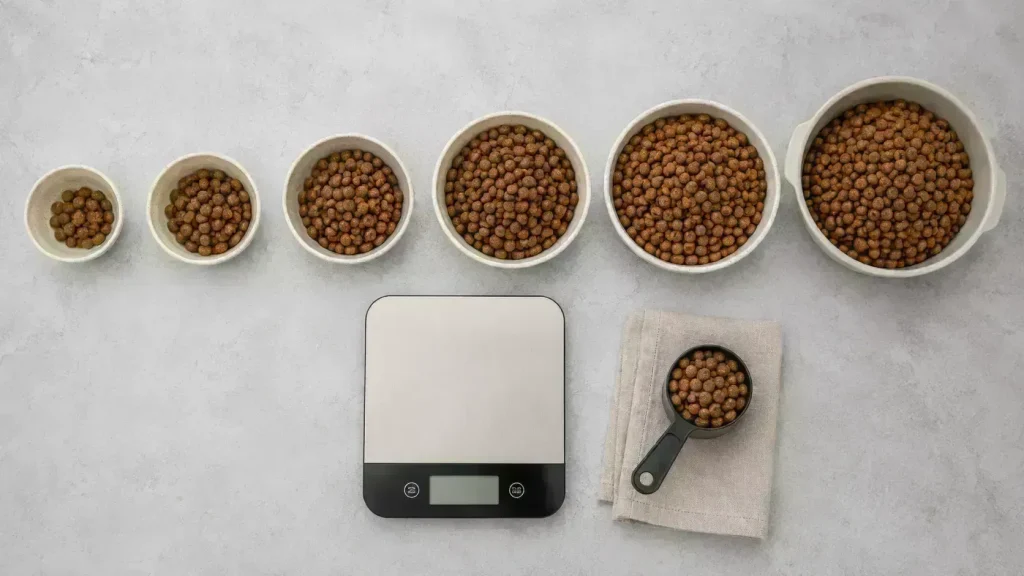
I prefer weighing food in grams because measuring cups are not always accurate. A cup can hold different amounts depending on kibble shape, size, and how tightly it is filled.
I also write down the full daily amount before splitting it into meals. This helps prevent family members from feeding the puppy twice.
For training, I take some kibble from the daily food allowance and keep it in a small container. The puppy still receives rewards, but the treats do not quietly add hundreds of extra calories.
My final rule is simple: watch the puppy, not only the chart. A chart gives you a starting number. Weight trend, ribs, waist, stool, appetite, and energy show whether that number is working.
Frequently Asked Questions
How much should a 2 kg puppy eat?
A broad dry-food estimate is about 55–100 g daily. The correct amount depends on age, calorie density, breed, and body condition.
How much should a 5 kg puppy eat?
A 5 kg puppy may eat roughly 110–195 g of dry food daily. Check the package because calorie density can change the gram amount.
How much should a 10 kg puppy eat?
A broad estimate is about 190–330 g of dry food daily. A young 10 kg puppy may need more calories than an older puppy of the same weight.
How much should a 20 kg puppy eat?
A 20 kg puppy may need about 315–550 g of dry food daily. Large-breed puppies should receive controlled portions of suitable growth food.
Should I feed my puppy by weight or age?
Use both. Weight helps estimate calories, while age helps determine growth needs and meal frequency.
How often should I weigh my puppy?
Weekly weighing works well during fast growth. After growth slows, every two weeks may be enough unless a veterinarian advises more frequent checks.
Can I rely only on the food package?
No. The package is a starting point. Adjust according to weight trend, body condition, activity, treats, and veterinary guidance.
Does wet food require different portions?
Yes. Wet food contains more water and usually fewer calories per gram, so the portion may weigh much more than a dry-food serving.
How do I know if my puppy is overweight?
The ribs may become hard to feel, the waist may disappear, and fat may collect over the body. Ask a veterinarian to confirm body condition.
What if my puppy always seems hungry?
Check the food amount, calorie content, growth trend, and treats. Constant hunger with weight loss, diarrhea, or poor growth needs veterinary attention.
Can treats replace part of a meal?
Use part of the puppy’s kibble for training. Most treats are not complete meals, so they should not replace a large part of balanced puppy food.
When should I switch to adult dog food?
Toy and small breeds may switch near 8–12 months. Medium breeds often switch near 10–12 months, while large and giant breeds may need growth food for 12–24 months.
Conclusion
Body weight is the best place to start when deciding how much a puppy should eat. However, the final portion must also reflect age, expected adult size, food type, activity, growth rate, treats, and body condition.
Weigh the puppy regularly, measure food in grams, and divide the daily total into suitable meals. Use feeding charts and calorie formulas as starting tools rather than fixed rules.
Contact a licensed veterinarian if appetite, growth, weight, stool, energy, or body condition changes unexpectedly. Early guidance is especially important for very small puppies, large and giant breeds, and puppies recovering from illness.